

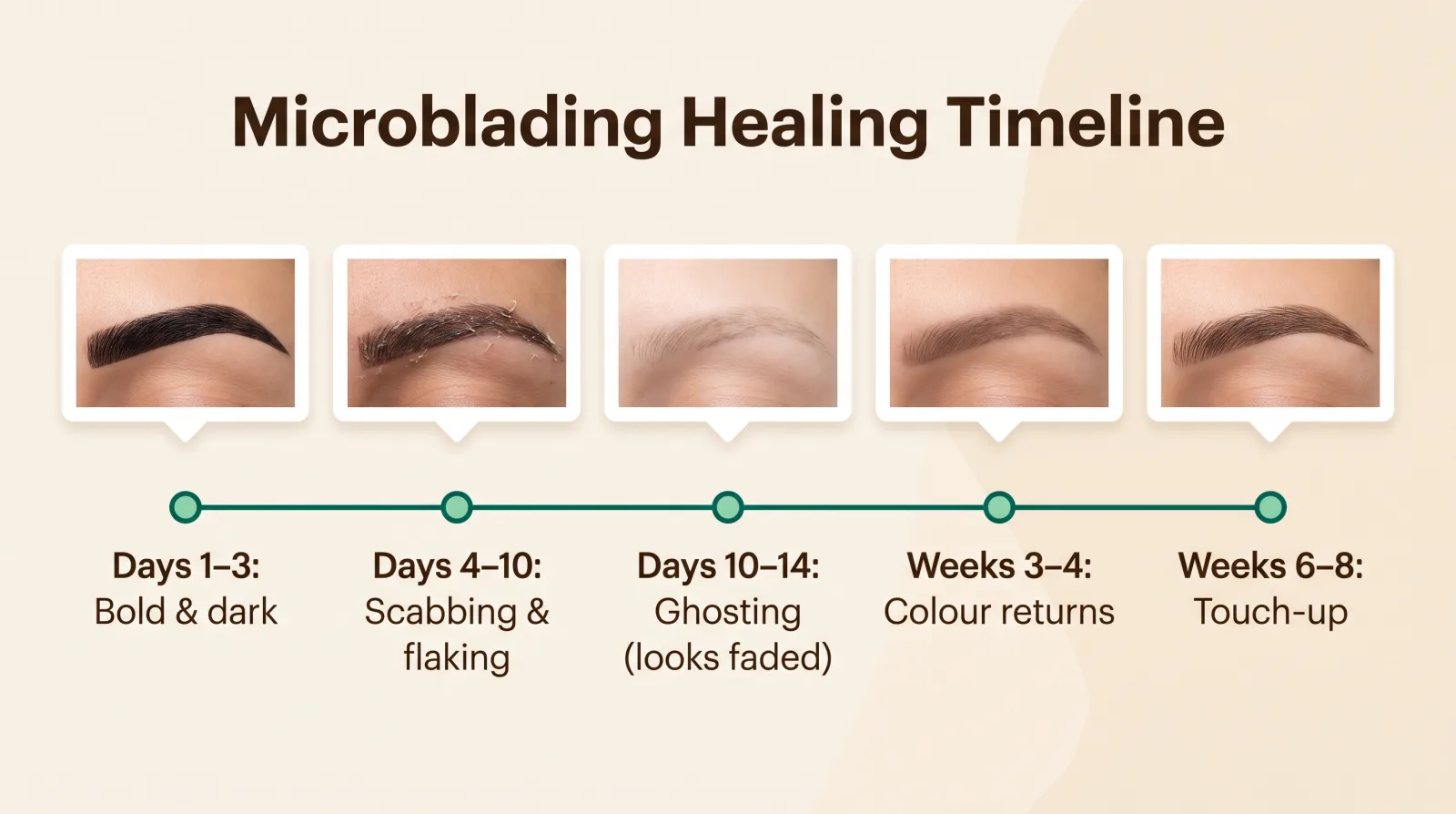
How long does microblading take to heal? The skin surface usually heals in about 2 weeks, and in our experience the final colour settles in about 4 to 6 weeks. We usually book a touch-up 6 to 8 weeks after the first session. The first week is the most visible: your brows look darker, then flake, then seem to fade before they soften into their real shade.
Day-by-Day Microblading Healing Timeline
Every face heals a little differently, so treat these as typical ranges, not a guarantee. Healthline notes that it takes about 7 to 14 days for the skin to begin to look healed and for the pigment to fade to its intended shade; the timeline below is what we usually see after our microblading service in Richmond Hill. It reflects our clinic experience, not a clinical standard.

| When | What you will see | What to do |
|---|---|---|
| Days 1–3 | Brows look sharp, bold and darker than they will end up. Mild redness and tenderness around the strokes; a little clear fluid may weep. | Gently blot with a clean, damp cotton pad as your technician instructs, then apply a thin layer of the aftercare balm. Keep the area dry in the shower. |
| Days 4–10 | Strokes begin to flake and form light scabs. Brows can look patchy and itchy. | Do not pick, scratch or peel. Keep sweat, steam and makeup away. Let flakes fall off on their own. |
| Days 10–14 | Most flakes are gone. Pigment can look faded or even missing; the skin surface feels smooth again. | Keep moisturising lightly and start wearing sunscreen once the skin is fully closed. Stay patient — this is the “ghosting” phase. |
| Weeks 3–4 | Colour slowly returns as the deeper layers settle. Strokes may still look uneven. | Avoid facials, peels and retinol near the brows. Take progress photos for your touch-up visit. |
| Weeks 4–6 | Colour looks softer and more natural; the final shade is mostly visible. Any gaps or light strokes are now clear. | Note where hair strokes are light or missing — that is what the touch-up fixes. |
| Weeks 6–8 (touch-up) | Healed brows are assessed; we add strokes where pigment did not hold. | Book your touch-up. Skipping it can leave light or uneven areas as they are. |
Why Your Brows Look Too Dark, Then Seem to Disappear (Ghosting)
Two questions we hear most are “Why are my brows so dark?” and “Where did my brows go?” Both are normal. Right after the session, pigment sits fresh in the skin, so strokes look bolder than your final shade. As the skin flakes during the first week or two, some pigment leaves with it.
Once the top layer has closed, a thin film of new skin sits over the pigment, and brows can look pale or almost blank for a short while. We call this ghosting. In most clients the colour comes back gradually over the next few weeks as that film clears. Wait until week 4 to judge your result.
Brows that are still very faint at your touch-up are exactly what the second session is for. Looking ahead, our guide on how to make microblading last longer covers the long game, once you are fully healed.
Scabbing and Peeling: What Is Normal and What Is Not
Light, thin flakes and tiny scabs on days 4 to 10 are a normal part of microblading. Healthline explains that microblading implants pigment into tiny cuts in the skin of your brows, and like any small cut, they form a thin crust while they heal. The golden rule is simple: never pick or peel. Pulling a scab early can lift pigment out with it and leave a gap that needs fixing.
Normal: mild redness, tightness, itching, light flaking, slight puffiness right after the session that settles quickly, and colour that looks uneven for a couple of weeks.
Not normal: Healthline says yellow-tinged discharge or excessive redness can be a sign of infection, and that you should see a doctor right away if the area swells, keeps scabbing after 2 weeks, or leaks pus.
The FDA also lists infection among the main complications of tattooing, including permanent makeup, particularly when equipment is not sterile. If anything on your brows looks like this, contact your doctor first and let us know afterwards.
Aftercare: What to Do and What to Avoid
Good aftercare is the single biggest thing you control. The basics are the same almost everywhere, and Healthline lists them: keep the area from getting wet for at least 7 days, skip makeup for at least a week, do not pick at scabs, and avoid saunas, swimming and heavy sweating until the skin is completely healed.
We usually ask clients to follow these rules for the first 7 to 10 days.

Do
- Apply only the balm your technician recommends, in a very thin layer.
- Use sunscreen on healed brows — Healthline notes it may help prevent fading.
Avoid
- Soaking, steam rooms, hot yoga and the pool until your technician says the skin has healed.
- Exfoliating products, chemical peels and retinol on the brow area until fully healed.
Thinking about injectables? Timing matters, so read how long to wait after microblading before getting Botox.
Healing After Your Touch-Up Session
Most clients need a touch-up, which we usually book about 6 to 8 weeks after the first session. Healthline also notes that a second visit, usually about 6 weeks after the first, is for a touch-up.
In our clinic, healing after a touch-up is usually faster and gentler than the first round. Fewer strokes are added, so we usually see less flaking and a shorter dark phase, often settling within about 7 to 10 days, with the final colour appearing around 2 to 4 weeks. Aftercare stays the same: dry, clean and hands-off.
Does Your Skin Type Change Healing?
It often does. Skin type affects how pigment sits and how it looks as it heals. These are patterns we usually see in our clinic, not rules.
| Skin type | What we usually see during healing |
|---|---|
| Oily skin | In our experience, pigment can look softer once healed and strokes may blur more than on other skin types. Clients with oily skin often benefit from a firmer touch-up plan and sometimes a different technique, such as a powder-style finish. |
| Normal or dry skin | Strokes tend to heal crisper and hold colour more evenly. Flaking can feel tighter or itchier, so a thin layer of balm matters. |
| Sensitive or reactive skin | Redness can last a little longer in the first days. We may suggest a patch test and a gentler session, and the balm should be fragrance-free. |
| Mature skin | Thinner skin can take pigment more softly, so a touch-up is especially useful to even out the strokes. |
Healthline reports the same direction: many microblading professionals believe people with dry skin get more satisfactory results than those with oily skin.
Tell us about your skin and health history at your consultation. For help choosing between techniques, see our comparison of tattooing vs Phibrows microblading.
Planning Microblading Around a Wedding or Event
Because the brows go through a dark phase, a flaky phase and a pale phase, microblading is not something to do the week before a big day. Here is the schedule we usually suggest.
- About 3 months before: have your first session, so there is time for healing and a touch-up.
- 6 to 8 weeks later: have your touch-up, then allow another 2 to 4 weeks for the colour to settle.
- Last 2 weeks: no new treatments near the brows.
If your date is closer than 8 weeks, talk to us before you book; it is often better to wait until after the event.
Is Microblading Right for You?
Microblading suits most healthy adults who want fuller, natural-looking brows, but it is not for everyone. Healthline advises avoiding microblading if you are pregnant, prone to keloids or have had an organ transplant.
- A good fit: sparse or over-plucked brows, gaps you fill in every day, or brows that are uneven.
- Talk to us first: very oily skin, a skin condition on or near the brows, or older permanent makeup that may need a different technique.
- Wait: if you have a big event in less than 8 weeks, or a sunburn or active breakout on the brow area.
How Long Does the Microblading Appointment Take?

People often mix up “how long does microblading take” with “how long does it take to heal”. The session itself is much shorter than the healing.
Healthline says the procedure typically takes about an hour, depending on your brows and the technician. Your first visit is longer because it also includes consultation, brow mapping and numbing; we will tell you how much time to set aside when you book. A touch-up is usually shorter.
Want to know about cost? Your exact quote depends on your brows and plan, so see our price list or call us for a consultation.
Frequently Asked Questions
When does microblading start to peel?
Most clients notice flaking starting around days 4 to 10. It is typically light and thin. Let the flakes fall off naturally rather than picking them.
When can I wash my eyebrows?
Healthline advises keeping the area from getting wet for at least 7 days, including in the shower. After that, clean gently as your technician instructs. We usually say 7 to 10 days; follow the instructions you were given.
When can I wear makeup on my brows?
Healthline recommends no makeup on the area for at least a week. We usually suggest waiting until the scabbing is over and the skin has closed, often about 10 to 14 days, and always using clean products.
When does the colour come back after microblading?
The colour usually looks faded around days 10 to 14 and then returns gradually over weeks 3 to 4. In our experience, most clients see the final shade at about 4 to 6 weeks. If it is still patchy then, your touch-up will fix it.
Golden Pulse Cosmetic & Laser Clinic · Unit A2, 9610 Yonge Street, Richmond Hill, ON
Call (416) 561-8803 — we will review your brows and explain the full healing plan at your visit.
Written and Reviewed by Shohreh
Certified Skin Care Specialist and Master Trainer in Permanent Makeup. Shohreh brings over 14 years of experience in advanced aesthetic treatments including laser hair removal, skin rejuvenation, facials, and permanent makeup.
At Golden Pulse, she is committed to delivering safe, personalized, and results-driven treatments using modern technology and proven techniques.


